Alexander Lam

Does Shopify chat slow down your store? Learn how chat widgets affect Core Web Vitals, what our Shopify research found, and how to keep Shopify chat without sacrificing page speed, conversions, or customer support using proven optimization techniques.
Key Takeaways
→ Shopify chat can hurt performance, but implementation matters more than the chat feature itself. Heavy JavaScript, persistent connections, and third-party integrations can slow Core Web Vitals if they load too early.
→ Our research found chat apps are common and can be surprisingly heavy. Around one in four Shopify stores use a support or chat app, and some chat integrations added more than 600 KB of JavaScript and over two seconds of execution time.
→ You don’t have to choose between speed and customer support. Deferring chat, loading it after your LCP element, removing unused scripts, and auditing app performance lets you keep conversions without sacrificing page speed.
Can Shopify Chat Slow Down Your Stores?
Short answer: yes. Live chat can slow your Shopify store down.
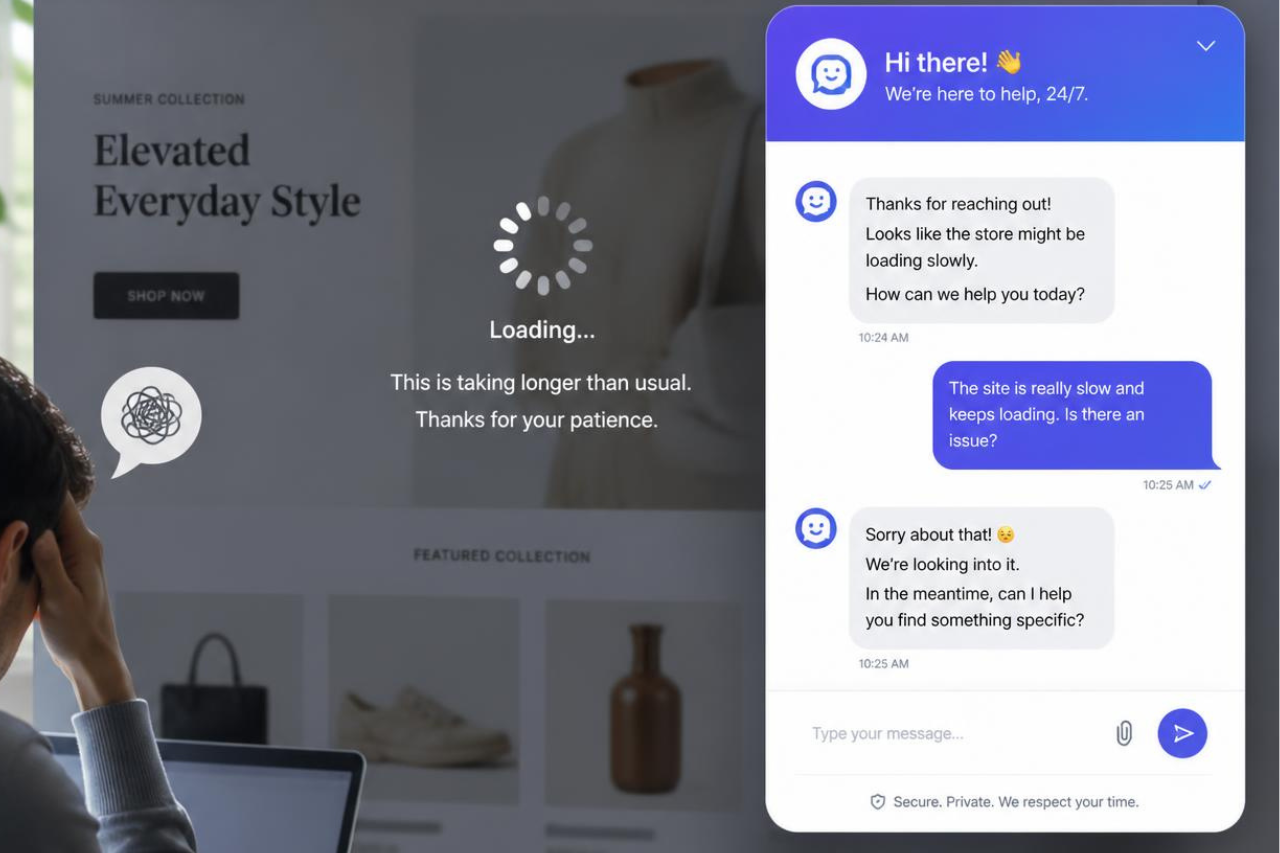
But before you rip out your chat widget, here’s the nuance. The problem isn’t live chat itself. It’s how most chat apps get built and installed. A well-implemented chat app barely makes a dent. A poorly-implemented one can tank your Core Web Vitals on its own.
The impact ranges wildly. Some stores won’t notice a thing. Others lose real seconds off their load time, just from one chat widget sitting in the corner of the screen. It all comes down to the app you pick and how it loads.
Merchants Are Already Running Into This Problem
This isn’t a hypothetical performance concern someone dreamed up in a lab. Shopify merchants are hitting this in the wild, right now, and posting about it in the Shopify Community.
Shopify chat apps are causing real PageSpeed drops for real merchants
One merchant had a store scoring 90+ on PageSpeed Insights. Solid, fast, everything working. Then they turned on Shopify’s built-in Chat App. Their mobile score dropped by roughly 35 points. The culprit? Extra scripts and fonts loading in behind the scenes, things the merchant never asked for and didn’t know were coming.
Another merchant ran a full performance audit on their store and found the same pattern from a different angle. After fixing everything else, images, theme bloat, unused code, one thing remained the clear bottleneck: their chat and inbox feature. It needed to stay on every page for support reasons, but it was still the single biggest thing slowing the site down.
Neither of these are edge cases. They’re the same story showing up twice, from two different merchants, on two different threads. That’s not a coincidence. That’s a pattern.
Why Live Chat Is Different From Most Shopify Apps
Not all Shopify apps cost you the same amount of speed. A review widget that shows five stars under a product photo is cheap to run. A live chat app is a different animal entirely, and it’s worth understanding why before you decide what to do about it.
A chat widget doesn’t just load. It stays running.
Most apps on your store do their job and get out of the way. An analytics tag fires off, sends its data, and finishes. Live chat doesn’t work like that.
A chat widget opens a connection to a server and keeps it open the whole time a visitor is on your site. Most modern chat apps do this through a persistent connection, commonly a technology called WebSocket, though some use other methods that behave similarly. Whatever the method, the goal is the same. Your customer types a message, and it needs to reach your support team instantly, not after a page refresh. To pull that off, the app has to stay active in the background, listening, the entire visit.
The hidden cost of persistent JavaScript
That “stay active” part is where the performance cost comes from. Keeping a live connection open means running a fairly large chunk of JavaScript, and running it continuously.
A typical chat app isn’t one small script. It’s often a small application in its own right, complete with its own framework, its own child scripts, and its own event listeners watching for clicks, scrolls, and messages. Add in features like visitor tracking, customer data synchronization, and analytics and reporting for your support team, and you’ve got a lot of code trying to do a lot of things, all before your customer has even decided if they want to chat.
Compare that to something like Shopify integration for order tracking or a simple recommendation engine showing product recommendations. Those tools can fetch data once and move on. Chat has to stay switched on, ready to react the second someone wants to talk. Omnichannel support and AI chatbot features add even more weight, since they’re often running extra logic to understand and route conversations.
All those event listeners don’t just cost load time either. They can also drag down your INP score, the metric that measures how quickly your site responds once someone actually clicks something.
Why every visitor pays for a feature only some people use
Here’s the part that stings a little. Most visitors never click your chat bubble. They browse, they add to cart, they check out, they leave, all without saying a word to your support team.
But the chat widget doesn’t know that in advance. It has to load fully, for everyone, just in case someone does want to chat. So every single visitor pays the full performance cost of a feature that maybe one in twenty people actually use.
That’s the real tension at the heart of this whole issue. Not “should you have chat,” but “should everyone have to download it before they’ve shown any interest in using it.”
What Our Shopify Research Found
We didn’t want to guess at this. We wanted numbers. So we pulled from our own research auditing real, live Shopify stores, and looked specifically at how chat and support apps behaved.
Support and chat apps are already common
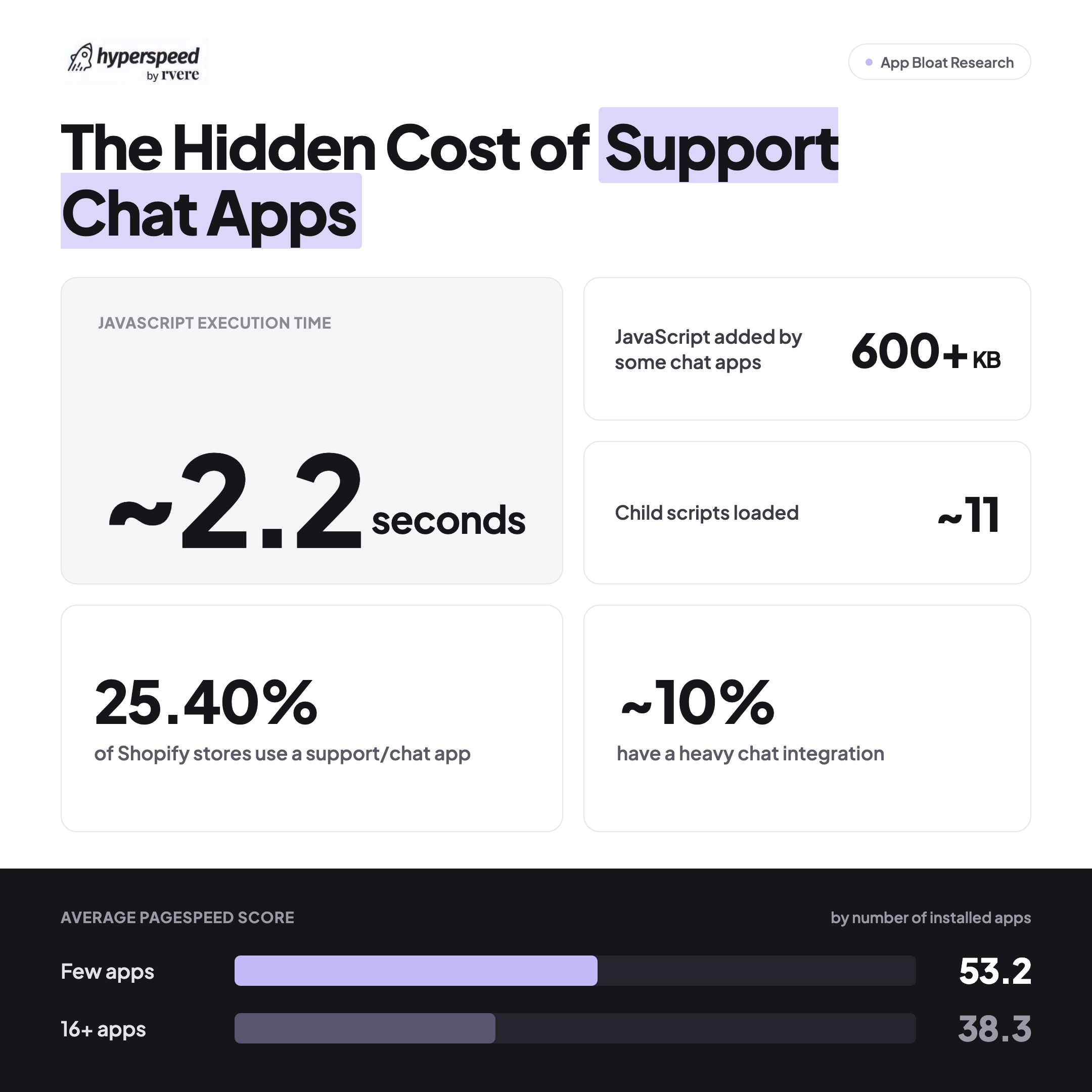
Chat isn’t a niche feature anymore. Shopify chat is common practice: in our dataset of active Shopify stores, 25.4% were running some kind of support or chat app. That’s roughly one in every four stores. If you’re running a chat in your store, you’re in good company. You’re also in a category we found worth paying close attention to.
Some chat apps became one of the largest scripts on the page
We went deeper in a separate audit of 1,166 Shopify storefronts, reading through the actual scripts loading on each one. Around 10% of stores were running a chat integration that, on its own, added more than 600 KB of JavaScript.
That single app pulled in roughly 11 child scripts and took about 2.2 seconds to fully execute. For context, that’s more code running than most entire Shopify themes. One chat bubble in the corner of the screen, quietly outweighing the rest of the store.
Chat is one contributor to growing app bloat
Chat rarely runs alone. It’s usually one app in a much bigger stack, and stacking apps has a real, measurable cost.
In our broader research on Shopify app counts, we found that stores running just a few apps averaged a PageSpeed score of 53.2. Stores running sixteen or more apps averaged 38.3. That’s a steep drop, and chat isn’t solely responsible for it. But as one of the heavier app categories we found, it’s often one of the bigger contributors when a store’s stack starts piling up.
| Metric | Finding |
| Shopify stores using a support/chat app | 25.40% |
| Stores with a heavy chat integration | ~10% |
| JavaScript added by some chat apps | 600+ KB |
| Child scripts loaded | ~11 |
| JavaScript execution time | ~2.2 seconds |
| Average PageSpeed (few apps) | 53.2 |
| Average PageSpeed (16+ apps) | 38.3 |
Chat isn’t the only app worth auditing this way. We ran the same teardown on Shopify’s product review apps and found a similar story playing out.
Is the Performance Cost Worth It?
This is the question that actually matters. Not “does chat slow down my store,” because yes, it can. The real question is whether that cost is worth paying.
Live chat can absolutely increase conversions
Chat isn’t just a nice-to-have. It answers questions the moment a customer has them, right when they’re deciding whether to buy. That kind of instant customer service can be the difference between someone completing a purchase and someone abandoning their cart because they weren’t sure about sizing, shipping, or returns.
The lift isn’t a myth, either. Research shows the average conversion increase from adding live chat at around 20%, with some case studies reporting 30% or more. Visitors who actually use chat before buying are roughly 2.8 times more likely to convert than those who don’t. Chat tends to lift more than just conversion rate too. Customers who chat before making a purchase spend, on average, about 60% more per order than those who don’t.
That’s the case for keeping chat around. The question was never whether it works. It’s whether it has to cost your whole store’s speed to get there.
Faster customer support reduces buying friction
Every question a customer has to email and wait on is a chance for them to lose interest and leave. Live chat removes that wait. Your support team can clear up doubt in real time, right on the product page, without sending anyone away from the online store to find an answer.
The challenge is making everyone download features only a few visitors use
Plenty of merchants have already made peace with this trade-off. As one store owner put it in the Shopify Community, if chat is increasing sales, the performance cost is worth accepting.
That’s a fair take, and we’re not here to argue you should drop chat for the sake of a few tenths of a second. But there’s an important nuance worth sitting with:
The problem isn’t that live chat exists. The problem is forcing every visitor to fully load it before they’ve shown any intention of using it.
That one idea changes how you should approach fixing this. You don’t need to remove chat. You need to change when it loads.
And the cost of getting this wrong compounds. Slow stores don’t just lose the occasional sale, they bleed revenue steadily as performance decays over time.
How to Run Live Chat Without Slowing Down Shopify
Good news: you don’t have to choose between fast and helpful Shopify chat. You can keep your chat widget, your support team, and your conversion boost, while getting most of that performance cost back.
Defer the chat widget until visitors interact
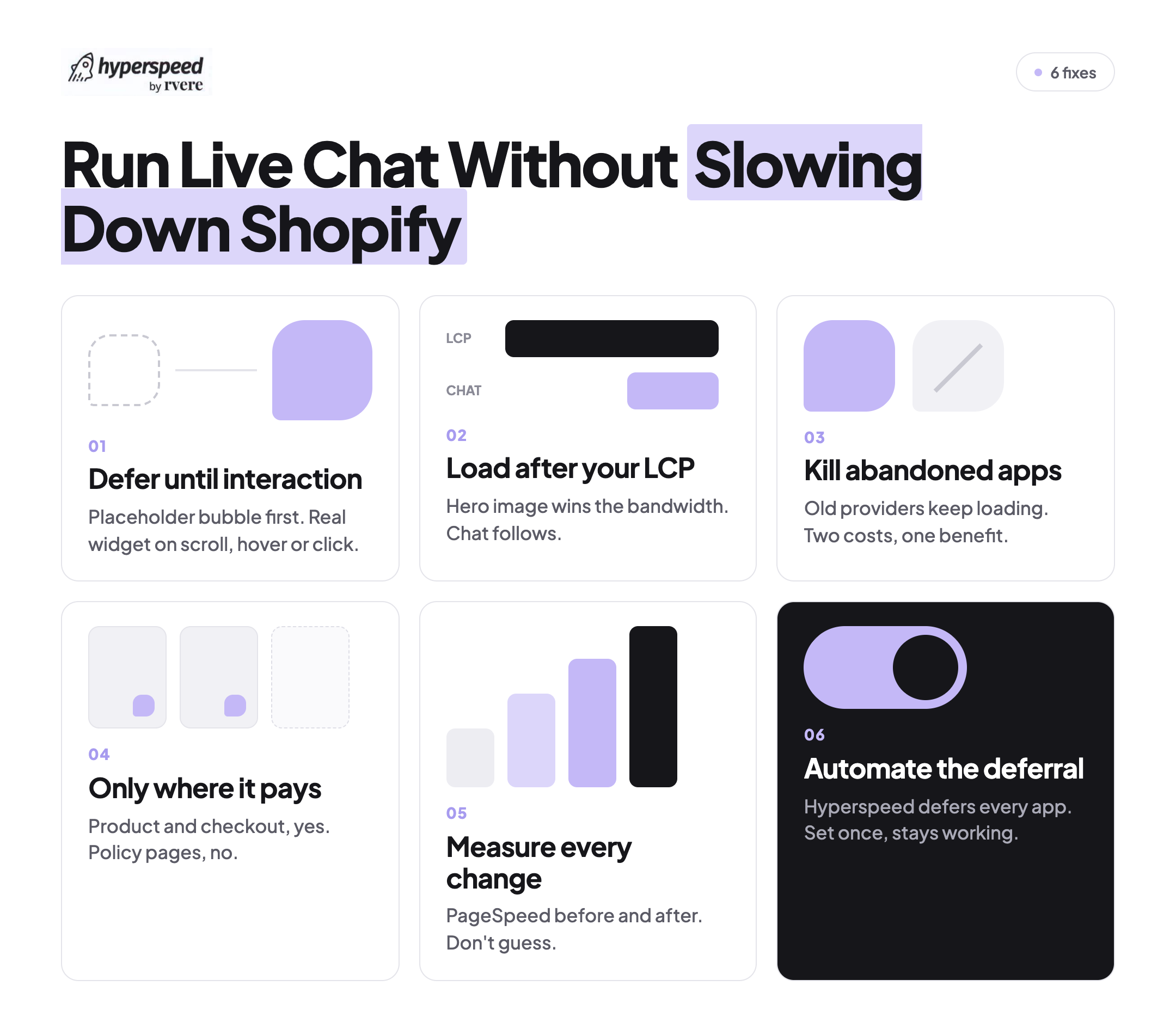
Instead of loading the full chat app the moment your page opens, load a lightweight placeholder bubble first. Save the real chat app, with all its scripts and its live connection, for when a visitor actually scrolls, clicks, hovers near it, or sticks around for a few seconds. Most people never touch it anyway, so there’s no reason to make them wait for it upfront.
If you want the deeper mechanics behind deferring scripts and protecting your critical rendering path, we’ve covered it in detail in how to fix render-blocking resources on Shopify.
Load chat after your LCP element
Your Largest Contentful Paint element, usually your hero image or main product photo, is the thing Google (and your customer) judges your speed by first. Chat competing with that image for bandwidth is a fight your chat app doesn’t need to win. Let your above-the-fold content load first, then bring chat in afterward.
Remove duplicate or abandoned chat apps
If you’ve switched chat providers at some point, check that the old one is actually gone. It’s shockingly common for a leftover script from a previous app to keep loading quietly in the background, long after anyone stopped using it. You’re paying the performance cost of two chat apps for the benefit of zero.
Limit chat to pages where it adds value
Not every page needs the same level of support presence. Product pages and checkout are where questions happen, that’s where chat earns its keep. Your blog posts or your shipping policy page probably don’t need the full weight of a live messaging app running in the background.
Monitor Core Web Vitals after every change
Don’t guess whether a change helped. Check. Run your store through PageSpeed Insights before and after adjusting your chat setup, and keep an eye on your Core Web Vitals over time. Small changes add up, and you want to know they’re actually working.
Automate script deferral instead of maintaining theme edits
Manually editing theme code to defer every app is a lot to keep up with, especially as your app stack changes over time. Platforms such as Hyperspeed automate app deferral across your Shopify store, allowing chat and other third-party scripts to load without competing with critical content. Set it up once, and it keeps working as you add or swap apps later.
Choosing a Shopify Chat App That Respects Performance
If you’re shopping for a new chat app, or auditing the one you already have, it helps to know what’s actually worth the performance cost, and what’s just adding weight.
Features worth paying for
Some features earn their keep.
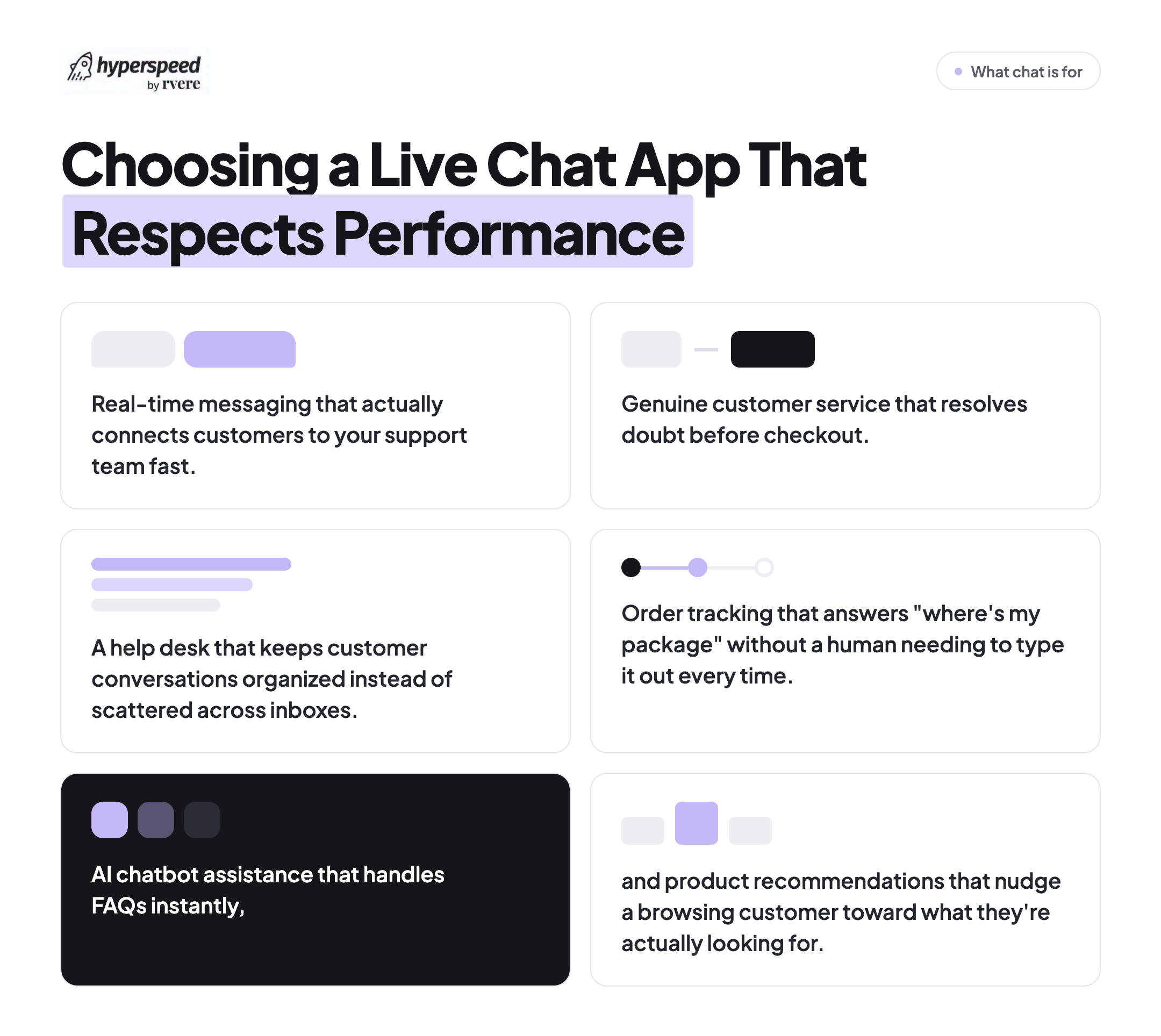
- Real-time messaging that actually connects customers to your support team fast.
- Genuine customer service that resolves doubt before checkout.
- A help desk that keeps customer conversations organized instead of scattered across inboxes.
- Order tracking that answers “where’s my package” without a human needing to type it out every time.
- AI chatbot assistance that handles FAQs instantly, and product recommendations that nudge a browsing customer toward what they’re actually looking for.
These features tend to show up directly in your conversion rate and cart abandonment numbers, which makes the performance trade worth considering seriously.
Features that often create unnecessary overhead
Other features cost you speed without giving much back. Here’s what tends to add weight without earning it.
Always-on visitor tracking. Watching every visitor’s movements in real time sounds useful, but most stores never look at that data closely enough to justify running it on every single page load.
Excessive analytics and reporting. Shopify already gives you solid reporting. A chat app layering its own dashboard on top is often just duplicating numbers you can already see elsewhere, at a real cost to load time.
Too many bundled integrations. Every integration a chat app connects to, whether it’s a CRM, a marketing tool, or a helpdesk, pulls in its own scripts. The more boxes an app checks, the heavier it usually gets.
Heavy AI processing for simple questions. Full language-model style AI is impressive, but a lot of what customers ask (“where’s my order,” “what’s your return policy”) is answered just as well by a simple FAQ page, without the extra JavaScript.
Duplicate customer data syncing. If the same customer data is being pushed to your chat app, your CRM, and your email platform separately, you’re paying the performance cost of syncing three times over instead of once.
Questions to ask before starting a free trial
Before you commit, even to a free trial, it’s worth asking a few pointed questions.
- Does this app support deferred or lazy loading out of the box, or will you need to configure that yourself?
- How many child scripts does it load, and is that documented anywhere?
- Does it offer omnichannel support like WhatsApp, or is it chat-only?
- Can you restrict where it loads, like limiting it to checkout and product pages?
- And does the app’s own marketing talk about performance at all, or does it only talk about features?
A chat app that can answer those questions confidently is one that was built with real Shopify stores in mind, not just a generic widget dropped into an ecommerce theme as an afterthought.
So, Does Live Chat Slow Down Shopify Stores?
Live chat isn’t the enemy here. Slow, careless implementation is.
The stores that get this right aren’t the ones running zero apps. They’re the ones making every app, chat included, earn its place on the page. Defer what doesn’t need to load immediately. Remove what’s no longer in use. Measure what you change instead of guessing.
Get that right, and you keep the conversions live chat brings in, without asking every visitor to pay for it upfront. That’s the whole idea. Fast and helpful were never actually in competition. Most stores just never set chat up to do both.
If you’d rather not comb through theme files to make that happen, that’s exactly the kind of work Hyperspeed handles automatically, deferring Shopify chat and every other third-party script so your store stays fast without losing the features that drive sales.
Compare how fast your store is to a huge sample of other stores. Get benchmarked and find out where you can improve your speed to make more sales. How fast is your Shopify store?
Frequently Asked Questions
Does Shopify chat slow down stores?
Yes. A live chat app can slow a Shopify store if it loads large JavaScript files, third-party integrations, or AI chatbot features on every page. A lightweight chat widget loaded after critical content usually has far less impact on page speed and Core Web Vitals.
Why does a Shopify chat app affect page speed?
Most chat apps load scripts for real-time messaging, visitor tracking, customer data, analytics and reporting, and Shopify integration before visitors interact with them. That extra browser work competes with page content and can delay rendering on your online store.
Do all Shopify live chat apps have the same performance impact?
No. Some live chat apps are lightweight, while others bundle AI chatbot tools, help desk features, WhatsApp, analytics, and multiple integrations. Performance depends more on how the app loads than the brand or the number of customer support features it offers.
Can an AI chatbot be slower than a regular live chat widget?
Yes. An AI chatbot often requires larger JavaScript bundles, API requests, and automated responses that increase browser activity. A basic live chat widget focused on customer service and order tracking usually creates less overhead than advanced AI features.
Should I remove live chat to improve my Shopify speed?
Not necessarily. Live chat can improve customer service, reduce cart abandonment, and increase conversions. Instead of removing it, defer the chat widget until interaction, remove unused integrations, and monitor Core Web Vitals after making changes.
When should a live chat widget load on a Shopify store?
The best practice is to load the chat widget after your largest visible content has loaded or after a visitor scrolls, clicks, or stays on the page briefly. This protects the shopping experience while keeping customer support available when customers need it.
Can live chat increase Shopify conversions?
Yes. Live chat can increase conversions by answering questions quickly, providing product recommendations, supporting customer conversations, and reducing purchase hesitation. The goal is balancing better customer support with a fast online store.
How can I tell if my chat app is hurting performance?
Run Lighthouse or PageSpeed Insights before and after installing the app. Compare Core Web Vitals, script size, JavaScript execution time, and network requests. If performance drops noticeably, review the chat app’s loading behavior and integrations.
What features make a chat app heavier than necessary?
Features such as always-on visitor tracking, omnichannel support, customer data syncing, analytics and reporting, AI chatbot tools, WhatsApp, and multiple helpdesk integrations often add scripts. Enable only the features your support team actually uses.
How can I reduce the performance impact of a Shopify chat app?
Defer the live chat script until interaction, load it after your LCP element, remove duplicate customer support apps, limit unnecessary integrations, and audit performance regularly. Tools like Hyperspeed can also automate app deferral to reduce loading overhead.